For Research Use Only
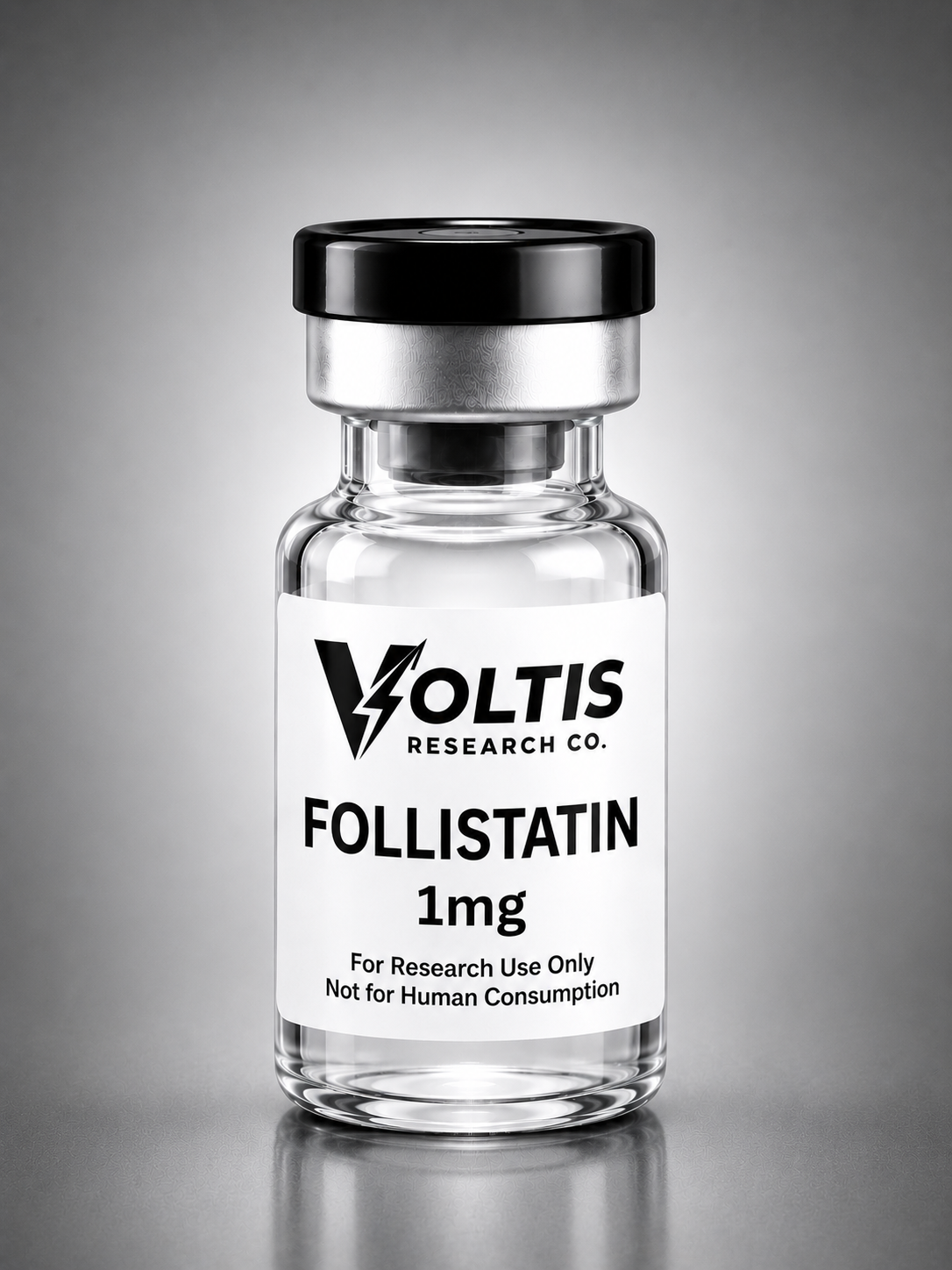
Follistatin-344 (FST344) is a recombinant research protein associated with the follistatin family of extracellular binding proteins.
Follistatin is best known for its ability to bind and regulate several members of the TGF-β superfamily, particularly activins and myostatin (GDF-8).
Because myostatin is an important negative regulator of skeletal-muscle growth, follistatin has become a significant research target in studies involving muscle development, tissue growth, cellular differentiation, regeneration, and TGF-β-family signaling.
Follistatin research includes:
Follistatin functions primarily as an extracellular binding protein.
It can bind activins and other related TGF-β-family ligands, limiting their ability to activate their respective receptors.
A simplified pathway is:
Follistatin → Ligand Binding → Reduced Activin/Myostatin Signaling → Changes in Cellular Growth & Differentiation
For skeletal-muscle research, the relationship with myostatin is particularly important.
Myostatin (GDF-8) is produced primarily in skeletal muscle and acts as a powerful regulator that limits excessive muscle growth.
Simplified:
Myostatin → Activin Type II Receptors → SMAD Signaling → Restriction of Muscle Growth
Follistatin can bind myostatin and interfere with its receptor interaction.
Researchers therefore investigate:
Follistatin ↑ → Myostatin Signaling ↓ → Altered Muscle-Growth Regulation
This mechanism has produced substantial interest in follistatin for experimental models of skeletal-muscle development and muscle-wasting disorders.
Follistatin biology extends well beyond myostatin.
Its strong interaction with Activin A is central to its physiological function.
Activins participate in:
Follistatin can sequester activin and regulate its availability to activin receptors.
This is why follistatin should not be described simply as a “myostatin blocker.” Its biological effects involve a considerably broader signaling network.
Experimental manipulation of the follistatin–myostatin–activin system has produced substantial changes in skeletal-muscle mass in animal models.
Researchers investigate relationships involving:
Follistatin ↔ Myostatin ↔ Activin ↔ Muscle Growth
Research areas include:
These experimental findings should not be interpreted as establishing FST344 as a proven muscle-building treatment in humans.
This distinction is particularly important for the Voltis listing.
FST344 refers to a follistatin precursor containing 344 amino acids.
Naturally occurring follistatin biology also includes important isoforms commonly described as:
FST315 — a circulating form with relatively greater systemic distribution.
FST288 — a shorter form with stronger association with cell surfaces and extracellular matrices.
Because these molecules can differ in localization and biological activity, findings involving one follistatin form should not automatically be attributed to FST344.
For Voltis, the vial label, product specification and COA should all identify the same molecular form.
Follistatin provides researchers with an important way to investigate a biological regulatory system controlling tissue growth.
Key relationships include:
Follistatin → Myostatin / Activin Regulation → SMAD Signaling → Cellular Growth & Differentiation
Researchers study this system in connection with:
✔ Premium Research Grade
✔ Follistatin-344 (FST344)
✔ Recombinant Research Protein
✔ Third-Party Tested (COA Available)
✔ Identity & Purity Verification
✔ Batch & Lot Traceability
✔ Secure Professional Packaging
✔ Laboratory Research Only
FST344 may be investigated in laboratory models involving:
Store according to the product’s batch-specific stability documentation.
Protect lyophilized material from excessive heat, moisture, and direct sunlight.
Following preparation for laboratory experiments, use validated laboratory storage procedures and minimize unnecessary temperature cycling or repeated freeze-thaw exposure.
Follistatin is sometimes marketed simply as a “myostatin inhibitor.” That’s incomplete.
Follistatin interacts with multiple TGF-β-family ligands, especially activins, meaning experimental manipulation can potentially affect biological pathways extending well beyond skeletal muscle.
Additionally, results from gene-therapy studies, animal models, FST288/FST315 research, or other follistatin constructs should not automatically be presented as evidence for a particular FST344 product.
For Research Use Only.
Follistatin-344 is an investigational research protein. Experimental evidence involving follistatin, myostatin inhibition, or related signaling pathways should not be interpreted as establishing FST344 as a safe or effective muscle-building or therapeutic intervention in humans.
This Voltis product is intended exclusively for laboratory research and analytical purposes.
Not intended for human or veterinary use.
At Voltis Research Co., quality begins with verification. This is particularly important with recombinant proteins such as FST344, where researchers need confidence in molecular identity, purity and batch consistency.
Qualifying batches undergo independent third-party analytical testing, with batch-specific Certificates of Analysis available to document identity and purity.
⚡ Research-Grade Quality
⚡ Independent Third-Party Testing
⚡ Batch-Specific Certificate of Analysis (COA)
⚡ High-Purity Research Compounds
⚡ Rigorous Quality Control
⚡ Secure Professional Packaging
⚡ Transparency, Consistency & Reliability
Powering Discovery Through Quality Research.
$100.00
Related Products
Voltis supplies peptides and research compounds intended for laboratory and research purposes only.
These products are not approved for human consumption and have not been evaluated by the FDA.
By entering this website, you acknowledge that you are at least 21 years of age and understand the intended use of these products.
Added to cart
Check out our shop to see what's available