Free shipping on orders over $100 ✦ Research-Grade Purity ✦ Rigorously Tested ✦ Science-Backed Formulas

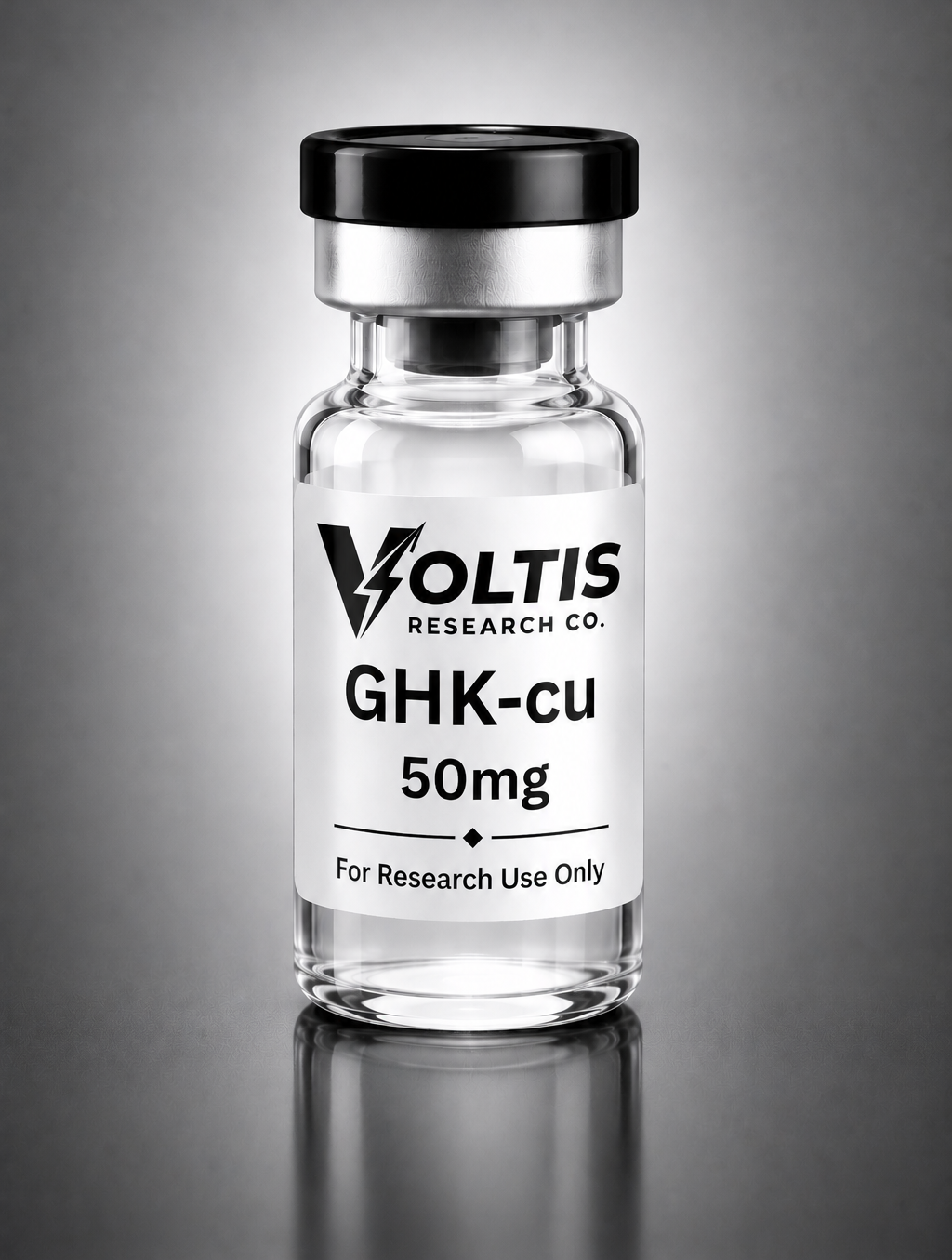
GHK-cu 50mg

GHK-Cu

Copper Tripeptide • Tissue Remodeling & Regenerative Biology Research

For Research Use Only

Overview

GHK-Cu (Glycyl-L-Histidyl-L-Lysine Copper) is a naturally occurring copper-binding tripeptide complex formed when the peptide GHK binds a copper ion (Cu²⁺).

GHK occurs naturally in human plasma and other biological fluids and has been extensively investigated for its involvement in tissue remodeling, extracellular-matrix regulation, cellular repair signaling, and copper transport biology.

Researchers have investigated GHK-Cu across numerous experimental models involving skin, connective tissue, fibroblasts, hair follicles, inflammatory signaling, and wound repair.


Research Areas

GHK-Cu has been investigated in research involving:

  • Collagen synthesis
  • Elastin production
  • Extracellular-matrix remodeling
  • Fibroblast activity
  • Keratinocyte biology
  • Wound-healing models
  • Tissue-repair signaling
  • Angiogenesis
  • Antioxidant pathways
  • Inflammatory signaling
  • Hair-follicle biology
  • Dermal regeneration
  • Copper metabolism
  • Cellular gene-expression pathways

Laboratory studies have demonstrated direct effects of GHK-Cu on collagen synthesis in cultured fibroblasts.


Mechanism Being Studied

GHK has a strong affinity for copper (Cu²⁺) and forms the biologically active GHK-Cu complex.

Researchers are investigating how this complex influences several interconnected processes:

GHK + Cu²⁺ → GHK-Cu → Cellular Signaling & Tissue Remodeling

Experimental research has associated GHK-Cu with:

  • Increased collagen synthesis
  • Elastin regulation
  • Glycosaminoglycan production
  • Fibroblast proliferation
  • Keratinocyte activity
  • Metalloproteinase regulation
  • Antioxidant enzyme activity
  • Growth-factor signaling
  • Cellular migration
  • Extracellular-matrix remodeling

Rather than functioning through one simple receptor pathway, GHK-Cu appears to influence a broad network of cellular and gene-expression processes.


Collagen & Extracellular-Matrix Research

One of the best-established areas of GHK-Cu research involves collagen and connective-tissue biology.

A laboratory study using fibroblast cultures demonstrated that GHK-Cu stimulated collagen synthesis at very low concentrations. Additional research has investigated its influence on elastin, glycosaminoglycans, decorin, metalloproteinases, and their inhibitors.

These properties make GHK-Cu particularly useful for research into:

Fibroblasts → Collagen/Elastin → Extracellular Matrix → Tissue Remodeling


Skin & Dermal Biology Research

GHK-Cu has an extensive history in skin and cosmetic-science research.

Studies and reviews have investigated its relationship with:

  • Skin elasticity
  • Dermal structure
  • Collagen production
  • Keratinocyte proliferation
  • Fibroblast activity
  • Photoaging biology
  • Oxidative stress
  • Skin-barrier physiology
  • Tissue remodeling

Some controlled topical studies have reported improvements in measures of aged skin, although formulation, delivery method, study size, and evidence quality vary considerably across the literature.


Hair-Follicle Research

GHK-Cu has also been investigated in relation to:

  • Hair-follicle size
  • Follicular signaling
  • Dermal remodeling
  • Angiogenesis
  • Cellular proliferation
  • Hair-transplant and follicular biology

Published reviews describe experimental findings involving increased hair-follicle size and other follicular effects, but these findings should not be presented as proof that GHK-Cu is an established treatment for human hair loss.


Why Researchers Study GHK-Cu

GHK-Cu is particularly interesting because one small copper-binding peptide appears capable of influencing multiple components of tissue remodeling simultaneously.

Researchers investigate connections between:

  • Copper transport
  • Cellular repair
  • Collagen and elastin
  • Extracellular-matrix turnover
  • Oxidative stress
  • Inflammatory signaling
  • Angiogenesis
  • Fibroblast function
  • Gene expression

This broad biological activity makes GHK-Cu an important experimental compound for investigating how cells coordinate damage response, repair, and remodeling.


Product Features

✔ Premium Research Grade
✔ High-Purity GHK-Cu
✔ Copper-Binding Tripeptide
✔ Third-Party Tested (COA Available)
✔ Identity & Purity Verification
✔ Secure Professional Packaging
✔ Laboratory Research Only


Common Research Applications

Researchers may investigate GHK-Cu in studies involving:

  • Extracellular-matrix biology
  • Collagen synthesis
  • Fibroblast physiology
  • Dermal biology
  • Wound-healing models
  • Tissue remodeling
  • Hair-follicle biology
  • Copper-peptide signaling
  • Oxidative-stress pathways
  • Cellular regeneration
  • Gene-expression research

GHK-Cu vs. AHK-Cu

These are related but distinct compounds:

GHK-Cu: Gly-His-Lys + Copper
AHK-Cu: Ala-His-Lys + Copper

GHK-Cu has a substantially broader published research literature, particularly involving collagen, extracellular-matrix remodeling, fibroblasts, and skin biology. Findings for one copper peptide should not automatically be attributed to the other.


Storage

Store according to the product’s batch-specific stability documentation.

Protect research material from excessive heat, moisture, and direct sunlight.

Following preparation for laboratory experiments, use validated laboratory storage procedures and minimize unnecessary temperature cycling or repeated freeze-thaw exposure.


Disclaimer

For Research Use Only.

GHK-Cu is intended exclusively for laboratory research and analytical purposes. Research involving GHK-Cu spans cell culture, animal models, and some topical human cosmetic studies; evidence varies substantially depending on the proposed application and route of exposure.

A Voltis research-grade GHK-Cu product should not be represented as an FDA-approved drug or as a treatment for wounds, hair loss, skin disease, or other medical conditions.

Not intended for human or veterinary use.


Why Choose Voltis Research Co.

At Voltis Research Co., quality begins with verification. Researchers deserve confidence that the compound identified on every vial accurately represents the material being investigated.

Qualifying batches undergo independent third-party analytical testing, with batch-specific Certificates of Analysis available to document identity and purity.

The Voltis Commitment

⚡ Research-Grade Quality
⚡ Independent Third-Party Testing
⚡ Batch-Specific Certificate of Analysis (COA)
⚡ High-Purity Research Peptides
⚡ Rigorous Quality Control
⚡ Secure Professional Packaging
⚡ Transparency, Consistency & Reliability

Powering Discovery Through Quality Research.

GHK-Cu (50 mg Vial) Dosage Protocol

$50.00

Category:
Voltis

I CERTIFY I AM AT LEAST 21 YEARS OF AGE

Sorry, your age does not permit you to enter at this time.

IMPORTANT DISCLAIMER

Voltis supplies peptides and research compounds intended for laboratory and research purposes only.
These products are not approved for human consumption and have not been evaluated by the FDA.
By entering this website, you acknowledge that you are at least 21 years of age and understand the intended use of these products.