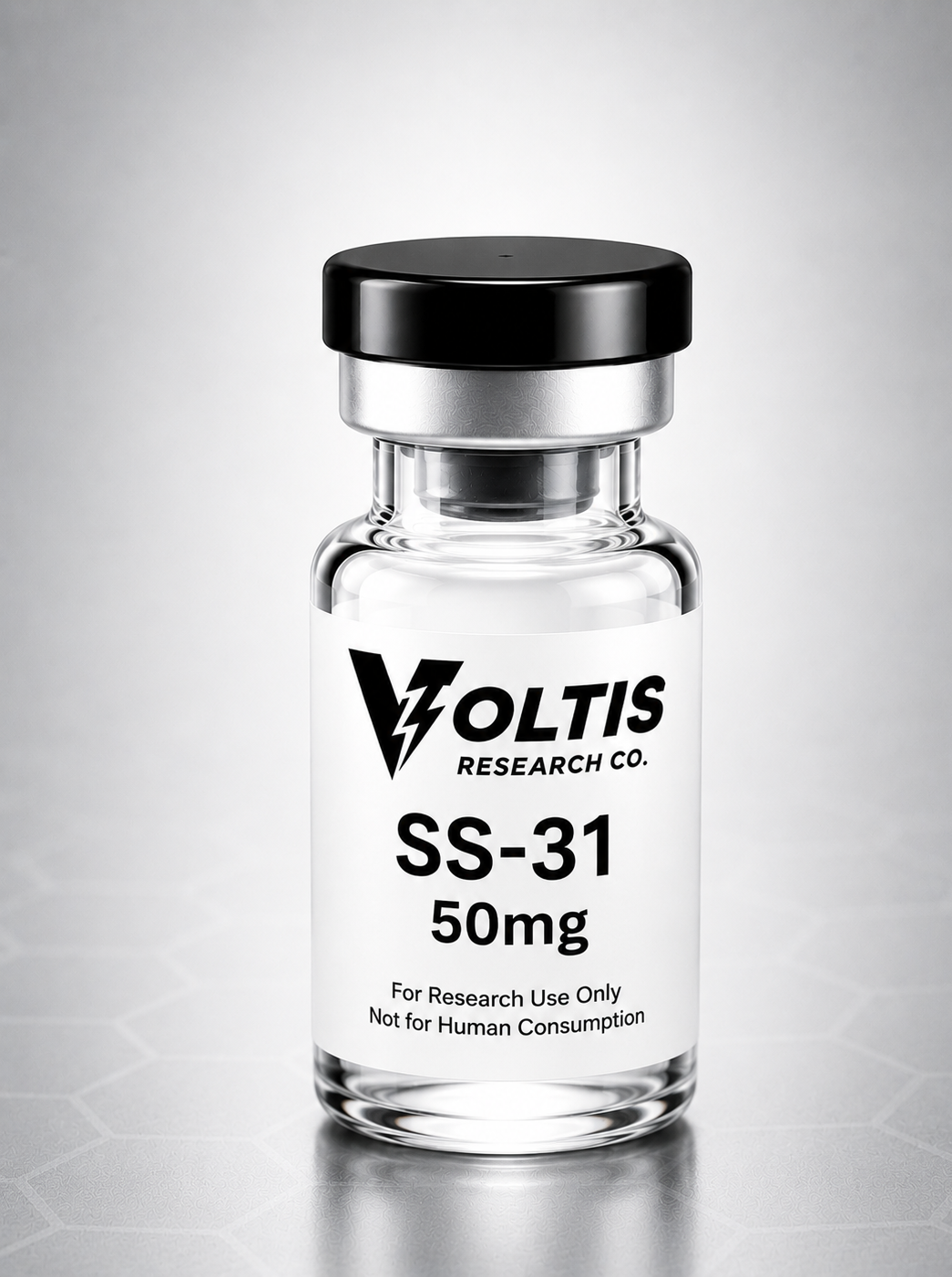
For Research Use Only
SS-31, also known as elamipretide, is a mitochondria-targeting tetrapeptide developed for research involving mitochondrial structure, cardiolipin biology, oxidative phosphorylation, cellular bioenergetics, and mitochondrial dysfunction.
Unlike compounds that primarily target nuclear or cell-surface receptors, SS-31 preferentially associates with the inner mitochondrial membrane, where it interacts with cardiolipin, a specialized phospholipid critical to mitochondrial membrane architecture and respiratory-chain function.
SS-31/elamipretide has been investigated in:
Research has progressed from cellular and animal models into multiple human clinical studies.
One of SS-31’s defining characteristics is its interaction with cardiolipin.
A simplified research pathway is:
SS-31 → Inner Mitochondrial Membrane → Cardiolipin Interaction → Membrane/Protein Organization → Mitochondrial Bioenergetics
Cardiolipin helps organize proteins involved in mitochondrial respiration and supports the architecture of mitochondrial cristae.
Research indicates that SS-31’s cardiolipin interactions can influence membrane electrostatics, respiratory-chain organization and mitochondrial function.
Cardiolipin is a distinctive phospholipid concentrated within the inner mitochondrial membrane.
It contributes to:
SS-31’s interaction with cardiolipin is therefore central to understanding its mitochondrial effects.
Mitochondria convert energy from nutrients into ATP, the primary energy currency used by cells.
A simplified pathway is:
Nutrients → NADH/FADH₂ → Electron Transport Chain → Proton Gradient → ATP
SS-31 research investigates whether stabilization and organization of the inner mitochondrial membrane can improve the efficiency of this process under particular conditions of mitochondrial dysfunction.
A randomized human study in older adults with impaired mitochondrial function reported an increase in an in-vivo measure of mitochondrial energetic capacity after elamipretide exposure, although this finding should not be generalized into a claim that SS-31 universally increases human energy or performance.
Mitochondrial electron transport can generate reactive oxygen species (ROS).
SS-31 has been investigated for effects involving:
Mitochondrial Dysfunction → Altered Electron Transport → ROS
and potentially:
Cardiolipin Interaction → Improved Mitochondrial Organization → Changes in ROS Production
Current mechanistic research goes beyond simply describing SS-31 as an “antioxidant”; its interaction with mitochondrial membranes and cardiolipin appears to be more fundamental to its biological activity.
Because skeletal muscle has extremely high energy requirements, mitochondrial function is particularly important to muscle physiology.
Researchers have investigated elamipretide in:
However, SS-31 should not be marketed broadly as a muscle-building, exercise-performance or recovery peptide based on this research.
SS-31 provides an unusually direct approach to investigating mitochondrial membrane biology.
Its research framework can be summarized as:
SS-31 → Cardiolipin → Inner Mitochondrial Membrane → Electron Transport → ATP & Cellular Bioenergetics
This makes SS-31 particularly interesting for research involving:
✔ Premium Research Grade
✔ High-Purity SS-31
✔ Mitochondria-Targeting Tetrapeptide
✔ Cardiolipin Research Peptide
✔ Third-Party Tested (COA Available)
✔ Identity & Purity Verification
✔ Batch & Lot Traceability
✔ Secure Professional Packaging
✔ Laboratory Research Only
Researchers may investigate SS-31 in laboratory models involving mitochondrial bioenergetics, cardiolipin biology, oxidative phosphorylation, electron transport, mitochondrial membrane structure, ATP production, oxidative stress, skeletal-muscle mitochondrial physiology and cellular stress responses.
This section is particularly important for the Voltis website because the situation has changed.
On September 19, 2025, the FDA granted accelerated approval to Forzinity (elamipretide) as the first treatment for Barth syndrome, specifically to improve muscle strength in adult and pediatric patients weighing at least 30 kg. The FDA describes it as a mitochondrial cardiolipin binder.
The pivotal evidence was based on a very small rare-disease population. The FDA reports that the controlled trial enrolled 12 patients, and accelerated approval carries requirements for additional confirmatory evidence.
Therefore:
Voltis SS-31 research material ≠ FDA-approved Forzinity
The Voltis product should not be represented as pharmaceutical elamipretide or as an FDA-approved treatment unless it independently meets the applicable regulatory requirements.
Store according to the product’s batch-specific stability documentation.
Protect lyophilized material from excessive heat, moisture and direct sunlight.
Following preparation for laboratory experiments, use validated laboratory storage procedures and minimize unnecessary temperature cycling or repeated freeze-thaw exposure.
For Research Use Only.
SS-31/elamipretide has substantial preclinical and clinical research, and an FDA-approved pharmaceutical elamipretide product now exists for a specific Barth syndrome indication.
A Voltis research-grade SS-31 product should not be represented as equivalent to that approved pharmaceutical product or as a treatment for mitochondrial disease, fatigue, aging, muscle weakness or other medical conditions.
This Voltis Research Co. product is intended exclusively for laboratory research and analytical purposes.
Not intended for human or veterinary use.
At Voltis Research Co., quality begins with verification. Researchers investigating mitochondrial-targeting peptides need confidence in the identity, purity and batch consistency of the material being studied.
Qualifying batches undergo independent third-party analytical testing, with batch-specific Certificates of Analysis available to document identity and purity.
⚡ Research-Grade Quality
⚡ Independent Third-Party Testing
⚡ Batch-Specific Certificate of Analysis (COA)
⚡ High-Purity Research Peptides
⚡ Identity & Purity Verification
⚡ Rigorous Quality Control
⚡ Secure Professional Packaging
⚡ Transparency, Consistency & Reliability
Powering Discovery Through Quality Research.
$90.00
Related Products

Voltis supplies peptides and research compounds intended for laboratory and research purposes only.
These products are not approved for human consumption and have not been evaluated by the FDA.
By entering this website, you acknowledge that you are at least 21 years of age and understand the intended use of these products.
Added to cart
Check out our shop to see what's available