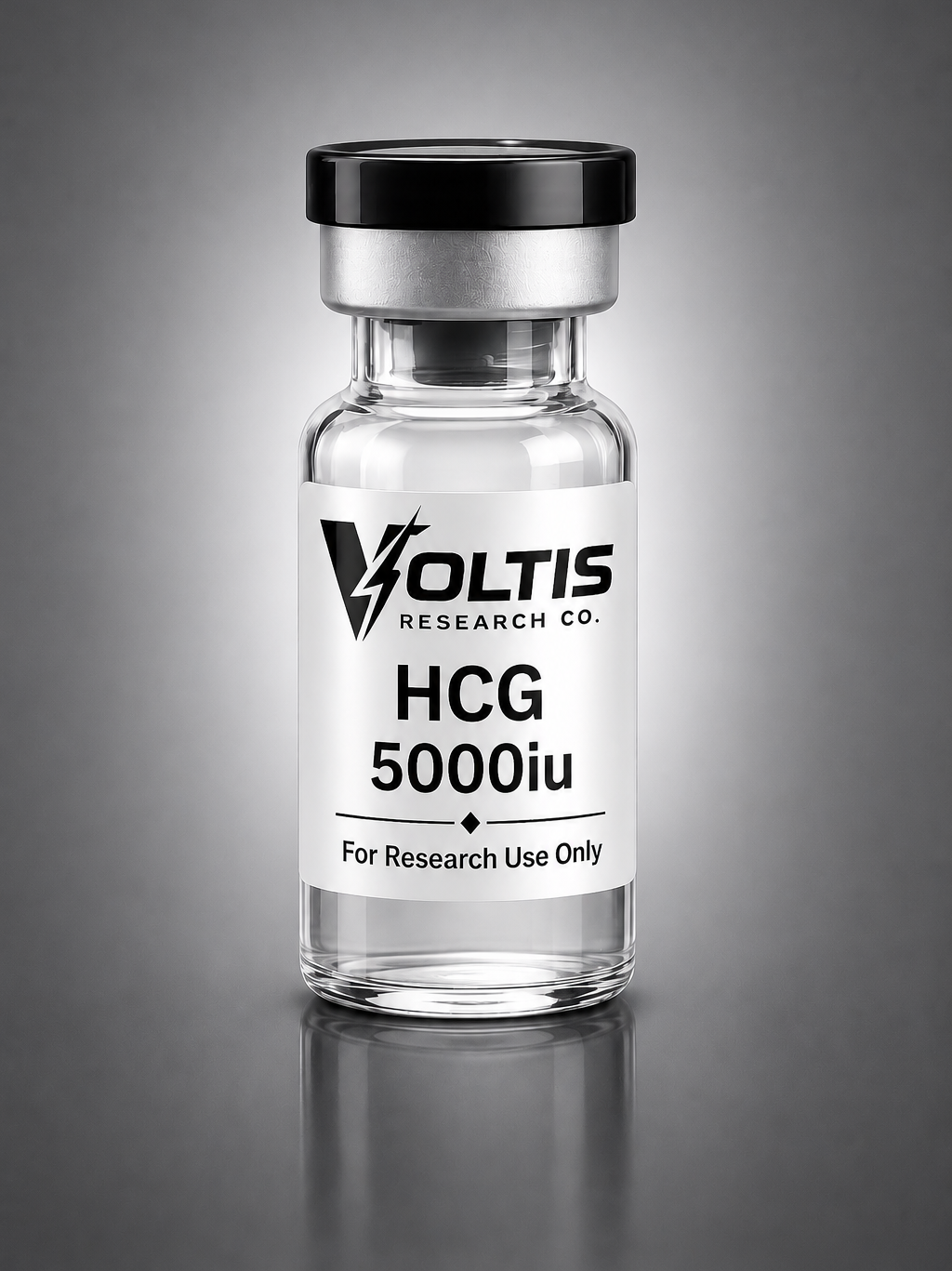
HUMAN CHORIONIC GONADOTROPIN (hCG)
Glycoprotein Hormone • LH-Receptor & Reproductive Endocrinology Research
For Research Use Only
Overview
Human Chorionic Gonadotropin (hCG) is a naturally occurring glycoprotein hormone produced primarily by placental trophoblast cells during pregnancy.
Structurally, hCG consists of two subunits:
α-subunit + β-subunit
The alpha subunit shares structural similarities with other glycoprotein hormones, while the β-subunit provides much of hCG’s biological specificity.
hCG has strong activity at the luteinizing hormone/choriogonadotropin receptor (LHCGR), making it an important research tool for studying reproductive endocrinology, gonadal signaling and steroidogenesis.
Research Areas
hCG is studied in connection with:
- Luteinizing hormone receptor signaling
- LHCGR biology
- Leydig-cell physiology
- Testicular steroidogenesis
- Testosterone biosynthesis
- Ovarian physiology
- Follicular maturation
- Ovulation biology
- Corpus luteum function
- Progesterone production
- Fertility physiology
- Placental biology
- Pregnancy signaling
- Hypothalamic-pituitary-gonadal axis research
Mechanism Being Studied
hCG binds to the same receptor activated by luteinizing hormone (LH):
hCG → LHCGR → G-protein Signaling → cAMP → Steroidogenic Pathways
Activation of LHCGR can stimulate downstream signaling involved in the synthesis of steroid hormones.
This creates the research relationship:
hCG → LH Receptor → Gonadal Signaling → Steroidogenesis
Male Reproductive-Endocrinology Research
In testicular physiology, LH normally stimulates Leydig cells.
hCG can activate the same receptor:
hCG → LHCGR → Leydig Cells → Steroidogenic Enzymes → Testosterone
This makes hCG particularly relevant to research involving:
- Leydig-cell function
- Intratesticular testosterone
- Testosterone biosynthesis
- Testicular endocrine signaling
- Spermatogenesis-related physiology
- Gonadal response to LH-receptor activation
One important scientific distinction is that hCG is not testosterone. Instead, it acts upstream by stimulating LH-receptor signaling.
Female Reproductive-Endocrinology Research
In ovarian physiology, hCG’s LH-like activity allows researchers to investigate:
LHCGR Activation → Follicular/Ovarian Signaling → Ovulation & Luteal Physiology
Research areas include follicular maturation, ovulation, corpus-luteum function, progesterone production and fertility-related endocrine signaling.
These mechanisms also explain why pharmaceutical hCG has established medical applications in reproductive medicine.
hCG vs. LH
Although hCG and LH activate the same receptor, they are not identical hormones.
They differ in molecular structure, glycosylation, circulating half-life and aspects of downstream signaling.
That makes hCG useful for investigating how different ligands can activate the same receptor while producing somewhat different biological signaling patterns.
Why Researchers Study hCG
hCG connects several fundamental areas of endocrine physiology:
hCG → LHCGR → Gonadal Signaling → Steroidogenesis → Reproductive Physiology
Researchers investigate hCG to better understand:
- LH-receptor biology
- Gonadal steroidogenesis
- Leydig-cell physiology
- Ovarian signaling
- Fertility biology
- Placental endocrinology
- Reproductive hormone signaling
- HPG-axis physiology
Product Features
✔ High-Purity hCG Research Material
✔ Glycoprotein Hormone
✔ LHCGR/LH-Receptor Research
✔ Third-Party Tested (COA Available)
✔ Identity & Potency Verification
✔ Batch & Lot Traceability
✔ Secure Professional Packaging
✔ Laboratory Research Only
For hCG specifically, I’d emphasize potency verification in addition to purity because biologic activity is especially relevant for a hormone preparation.
Important Regulatory Distinction
This section is essential for the Voltis page.
FDA-approved prescription hCG drug products exist and have specific indications. However, a research-grade Voltis hCG product is not automatically equivalent to an FDA-approved pharmaceutical hCG product.
Also, FDA labeling states that hCG has not been demonstrated to be effective adjunctive therapy for obesity and provides no substantial evidence that it increases weight loss beyond caloric restriction or causes a more desirable distribution of fat.
So I would avoid any Voltis claims involving:
“fat burning,” “rapid weight loss,” or an “hCG diet.”
Product Specification
For the actual Voltis listing, hCG should generally be identified by its verified biological potency, such as:
hCG — [verified IU per vial]
rather than describing it only in milligrams.
The exact IU statement needs to correspond to the manufacturer’s specification and batch-specific analytical/potency documentation.
Storage
hCG is a biologic molecule, so storage should follow the batch-specific stability documentation supplied with the material.
Protect lyophilized material from excessive heat, moisture and direct sunlight. Following preparation for laboratory experiments, use validated laboratory handling and storage procedures and minimize unnecessary temperature cycling.
Disclaimer
For Research Use Only.
Human chorionic gonadotropin is a biologically active glycoprotein hormone, and FDA-approved prescription hCG products exist for specific medical indications.
A Voltis research-grade hCG product should not be represented as equivalent to an FDA-approved prescription product or as a treatment for testosterone deficiency, infertility, weight loss or other medical conditions.
This Voltis Research Co. product is intended exclusively for laboratory research and analytical purposes.
Not intended for human or veterinary use.
Why Choose Voltis Research Co.
At Voltis Research Co., quality begins with verification. Biologically active research materials such as hCG require careful attention to identity, purity, potency and batch consistency.
Qualifying batches undergo independent third-party analytical testing, with batch-specific Certificates of Analysis available to document applicable quality specifications.
The Voltis Commitment
⚡ Research-Grade Quality
⚡ Independent Third-Party Testing
⚡ Batch-Specific Certificate of Analysis (COA)
⚡ Identity & Potency Verification
⚡ Rigorous Quality Control
⚡ Secure Professional Packaging
⚡ Transparency, Consistency & Reliability
Powering Discovery Through Quality Research.
HCG (5000 IU Vial) Dosage Protocol